Biography
Yousef Alloune
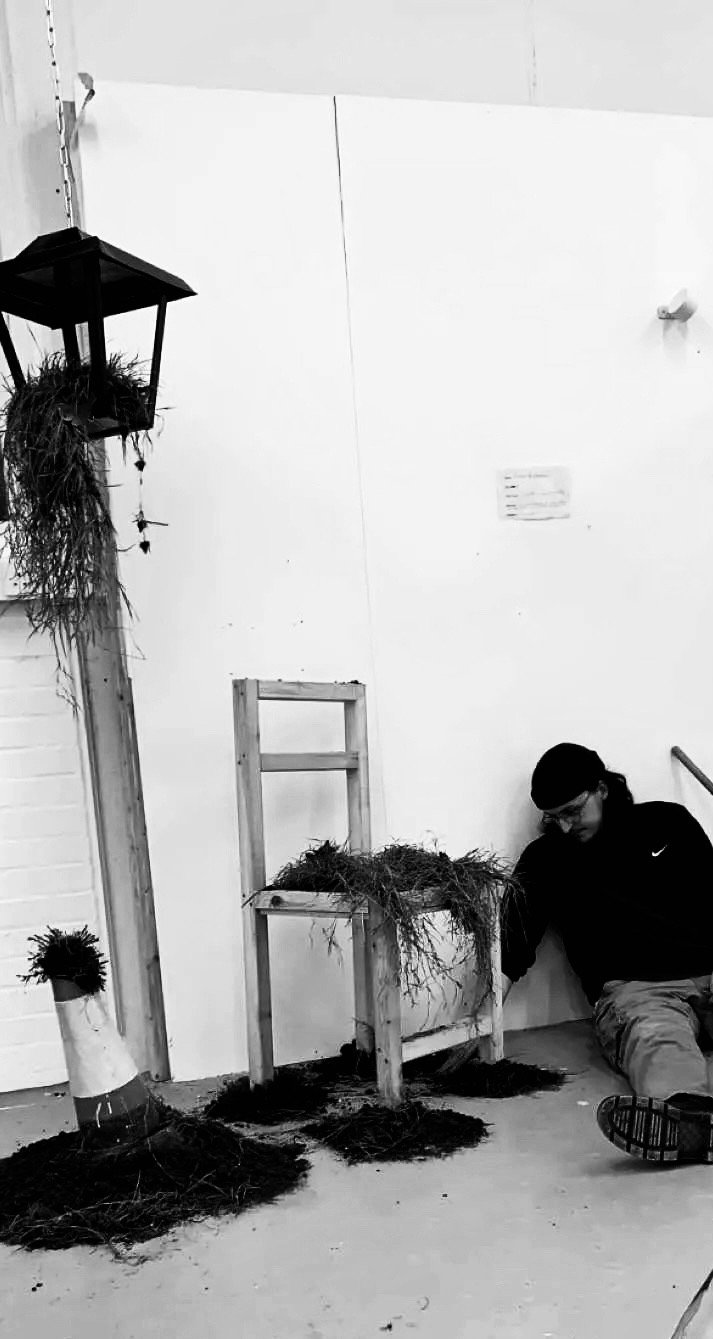
My name is Yousef Alloune, and I’m an artist shaped by both Algerian and British heritage. That mix of backgrounds has played a steady role in how I see the world and how I approach making work. Much of what I create comes from personal experiences, memories and the questions that sit with me over time. I focus on sculptural practices and tend to move between materials depending on what a piece asks for, but metal and wood have become the two mediums I return to most. I’m drawn to the weight, texture and history they carry, and I like how they respond differently to force, heat and time. I often think of Heidegger’s line, ‘Only if we are capable of dwelling, and here lies the reversal, only then can we build.’ It stays with me because each piece begins with that act of dwelling before it becomes something physical. Working with them lets me build forms that feel honest to the ideas I’m trying to explore, whether those ideas come from my cultural identity, the places I’ve lived, or the internal shifts that shape my day-to-day life. Artist Statement My practice is rooted in woodwork and metalwork, often incorporating found and recycled materials as both a conceptual and physical foundation. Through these processes, I explore ideas of displacement, lost heritage, and cultural identity, particularly in relation to the experience of moving between countries and the unstable sense of belonging that can follow. My work reflects on the ways individuals attempt to reconstruct a sense of “home” after displacement, and the inevitable compromises that occur when that home cannot be fully recovered.The objects I create often exist as partial reconstructions or fragmented structures. They reference domestic forms, tools, or architectural elements, but resist resolution. This incompleteness is intentional. It mirrors the experience of rebuilding a life in a new place, where familiarity is sought but never fully achieved. Instead, what emerges is something hybrid, shaped by memory, necessity, and adaptation. These works are not direct replicas of what has been lost, but negotiations between past and present.Central to my practice is the use of found and recycled materials. This choice is both practical and symbolic. For many people experiencing displacement, financial instability and shifting economic conditions mean that materials and resources must be sourced differently. What was once accessible may no longer be, and making becomes an act of improvisation. By working with discarded or repurposed materials, I reflect this reality while also drawing attention to overlooked value. These materials carry histories of use and neglect, which parallel the experiences of individuals whose skills, trades, or knowledge may not be recognised in a new cultural or economic context.My approach to making is largely intuitive. I work in response to the materials available to me, guided by a learned adaptability that comes from personal experience. Growing up with limited access to resources meant that I became familiar with multiple forms of making out of necessity rather than choice. This has shaped my relationship to craft, not as a fixed discipline, but as a flexible and responsive process. The act of making becomes a form of problem-solving, where constraints are not limitations but starting points.While my earlier work engaged more directly with themes of mental health, my current practice moves beyond that into a broader reflection on identity and lived experience. However, the psychological dimension remains embedded within the work. The sense of internal conflict, of existing between cultures and never fully belonging to one or the other, informs both the physical and conceptual structure of my pieces. My work can be understood as a form of re-enactment, a way of processing and externalising the instability I have experienced.This position of in-betweenness is something I have lived with for much of my life. Being perceived as “too Arab or African to be English” and “too English to be Arab or African” has created a constant sense of dislocation. Rather than attempting to resolve this, my work embraces it. It acknowledges that identity is not fixed or binary, but layered and evolving. Through making, I am not trying to define myself within existing categories, but to understand and accept the complexity of my own position.My influences include artists such as Lydia Ourahmane, Mona Hatoum, and Mike Nelson, whose practices engage with themes of displacement, material presence, and spatial experience. I am also informed by anti-craft approaches, as well as romantic and conversational modes of art-making, where narrative and material are closely intertwined. These influences support my interest in creating work that feels both personal and politically situated, without becoming didactic.Ultimately, my work is about communication. I want viewers to engage with my perspective, not as something distant or unfamiliar, but as something that resonates with broader experiences of class, migration, and belonging. While aspects of my background are shaped by ethnicity and displacement, many of the challenges I reference—financial hardship, adaptation, and resilience—are shared by a wide range of people. By presenting these experiences through material and form, I aim to create points of connection that go beyond surface-level differences.At the same time, I want the work to offer a sense of possibility. Despite the difficulties it references, it is not solely about loss. It is also about growth, community, and self-understanding. Through my own experiences, I have come to recognise that identity is not something that needs to be resolved into a single, fixed state. It can exist in flux, shaped by multiple influences and experiences. This realisation is something I hope to share, particularly with those who may feel similarly displaced or uncertain.Through sculpture and material practice, I continue to explore what it means to build, rebuild, and belong.